

How to strategically plan your science communication project
This is a working version of my SciComm Strategy 101 workshop.
Take one project you're planning (a talk, a video, an outreach event, a social account you keep meaning to start) and run it through five strategy pillars before you make anything.
Most science communication stalls in the same place. Not because the science is hard to explain, but because the project was never scoped. You start making before you've decided who it's for, and you end up with something technically accurate that lands with nobody.
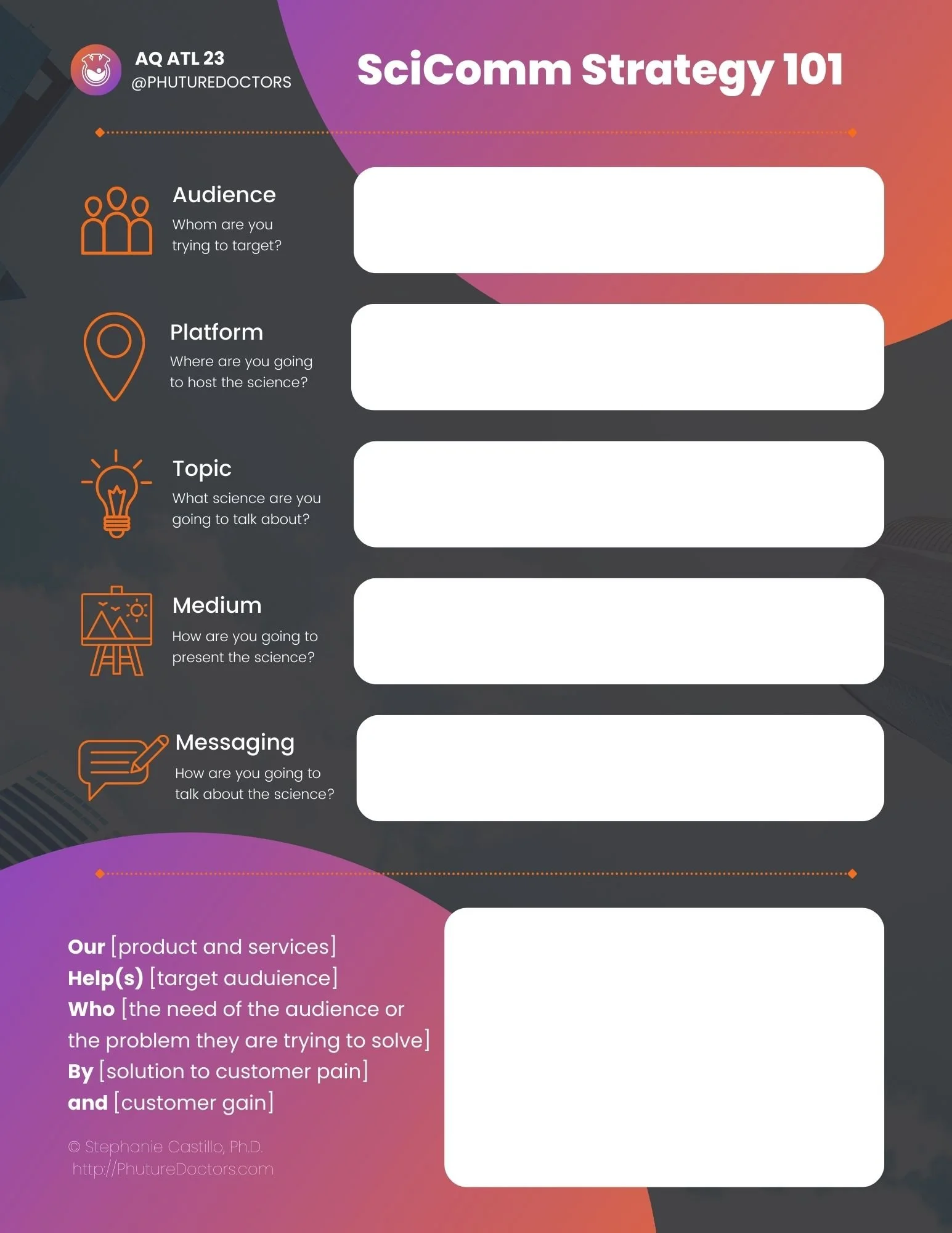
How to use the worksheet
Five decisions, in five boxes
Topic — what science are you talking about?
The box everyone thinks is the easy one. Write the specific thing, not the field. "My research" is not a topic. Narrow it until it fits in a sentence you'd say out loud to someone at a party.
Audience — who are you trying to reach?
This is the box that changes every box after it. Go past demographics. What does this group already know, what have they already been told, and what do they care about that has nothing to do with your science? If you can't answer that, you're guessing.
Platform — where will this live?
Where your audience already spends time, not where you already have an account. The place shapes the work. The same idea behaves differently in a lecture hall, a comment section, and a museum floor.
Medium — how will you present it?
Video, writing, art, a talk, a demonstration, data viz. Choose for the idea and for your actual capacity, not for what's trending. The best medium is the one you can finish.
Message — what are you actually saying?
Your objective in one line, and the story that carries it. This is the box most people skip, and it's the one that decides whether anyone remembers anything a week later.
Quick Tips
Work in pencil. The boxes talk to each other. It's normal to name an audience, get down to Medium, realize you can't produce that, and go back up. That's the worksheet doing its job, not you doing it wrong.
You don't have to start at Topic. Some projects begin with an audience you're trying to reach; others begin with a platform someone handed you. Start at whichever decision is already made and fill in around it.
Give it twenty minutes and one project. Trying to fill it out for your entire practice at once is how it ends up in a drawer.
Bring the workshop to your team
When you're done, you should be able to say the whole plan in one sentence: I'm making [medium] about [topic] for [audience] on [platform] so that they [message]. If that sentence comes out vague, the vague part tells you which box to go back to.
The workshop goes further than the worksheet can. We get into why some science communication lands while equally accurate work doesn't, how to research an audience you're not part of, how to structure research as a story, and a value proposition exercise for anyone building a project or a business around their SciComm.